Best PDF Accessibility Vendors for WCAG, Section 508, PDF/UA and ADA Title II Compliance (2026)

Best PDF Accessibility Vendors 2026

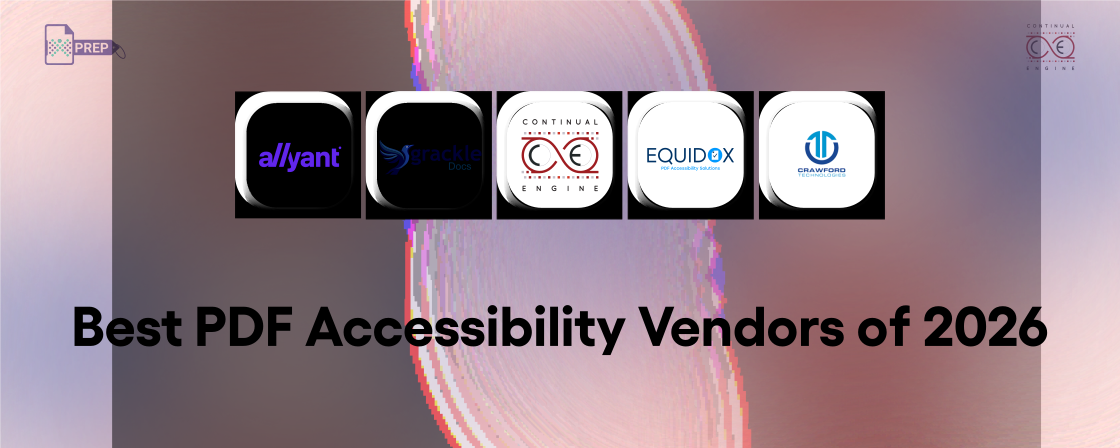
If you’re evaluating vendors to make your PDFs WCAG, ADA Title II, Section 508, PDF/UA and RPwD Act compliant in 2026, the right accessibility partner matters. Whether you’re dealing with complex tables, scanned documents, or interactive forms, the vendors below can help you close accessibility gaps and meet compliance standards. We’ve put together a list of the 10 best PDF accessibility vendors so you can compare coverage, turnaround, and pricing, and find the one that best fits your needs, budget, and workflow.

Choosing a PDF accessibility vendor is not just about fixing tags or passing an automated checker. It’s about secure workflows, assistive technology testing, and scale that holds up as your document volume grows.

10 Best PDF Accessibility Vendors for 2026

Vendor Offering Formats Supported API Integration Scalability Best For Turnaround Time
Continual Engine
  • Software + services (platform + expert team)
  • PDFs
  • Word, PowerPoint
  • HTML, EPUB and other digital content
  • Public remediation APIs (auto-tag, checker, audit)
  • Website PDF audit API
  • PDF-to-HTML export
  • Built for enterprise-scale and bulk PDF remediation
  • Higher education and local government entities (ADA Title II)
  • Publishers and content owners
  • Financial institutions
  • Software: typically a few minutes per file
  • Services: Within several hours to multiple days depending on volume and complexity
Allyant (CommonLook)
  • Software + services
  • Business and transactional PDFs (statements, forms, directories, etc.)
  • Workflow integrations and automation via partner tools
  • No widely marketed public remediation API
  • High-volume, templated document production
  • Enterprises with recurring PDF templates and strict compliance needs
  • Often within days for many projects; exact timing set per statement of work
Equidox
  • Software + services
  • PDFs from common office tools
  • Accessible HTML/ePub exports
  • Cloud or on-prem platform
  • No clearly advertised public remediation API
  • Batch processing and templated PDF workflows (e.g., statements, directories)
  • Teams wanting an easier-to-learn remediation tool plus optional services
  • Project-based; timelines quoted per engagement
GrackleDocs
  • Software + services
  • Google Docs, Sheets, Slides
  • Accessible PDF/HTML exports
  • Native Google Workspace add-ons
  • No general-purpose public API promoted
  • Suited to organizations producing many Google Workspace documents
  • Schools, universities and teams standardized on Google Workspace
  • Project-based timelines agreed during scoping; no generic SLA bands published
CrawfordTech (AccessibilityNow)
  • Software + services
  • Transactional and static PDFs
  • Accessible HTML5, braille, large print, audio
  • APIs/components for tagging and format conversion in document workflows
  • Large-scale, high-volume transactional environments
  • Banks, utilities, insurers and similar enterprises
  • Tight delivery windows possible; specific SLAs set per contract
Apex CoVantage / Documenta11y (incl. ADAPT AI)
  • Software + services (platform + services team)
  • PDFs (including scanned and complex layouts)
  • Office formats and EPUB3
  • Platform-level automation with ADAPT AI
  • No separately marketed public developer API
  • Built for bulk projects; over a million PDFs remediated
  • Organizations preferring a services-first model with AI in the workflow
  • Quoted per job; can handle from small sets to large batches with agreed timelines
TestPros
  • Services only (consultancy + remediation)
  • PDFs as part of wider document accessibility work
  • No public API (manual expert services)
  • Project-based work, especially for government and compliance-heavy clients
  • Government agencies and regulated organizations needing documented expert review
  • Simple PDFs: about 1–2 days
  • Moderate complexity: about 3–7 days
  • Highly complex: about 1–3 weeks
PDFix
  • Software only (SDK and tools)
  • PDFs as input
  • Accessible, tagged PDFs and other structured outputs
  • Developer SDKs and REST API for auto-tagging and accessibility
  • High-speed batch processing and enterprise workflows
  • Engineering teams embedding accessibility into their own products and back-end systems
  • Near real-time or batch, depending on customer implementation (no vendor-side service SLA)
Be Accessible
  • Services only
  • PDF
  • Word
  • Excel
  • PowerPoint
  • Scanned documents
  • No public API (manual remediation and training)
  • From small jobs to larger batches, generally priced by page/complexity
  • Organizations wanting human-led remediation and in-house training
  • Some projects turned around in roughly 24 hours; larger work varies by scope
Accessible.org
  • Services only
  • PDFs and other common document formats
  • No public API (project-based remediation)
  • Handles one-off files to large batches with consistent QA
  • Organizations prioritizing detailed QA and legal-ready conformance
  • Good turnaround time with capacity for large batches; timing agreed per engagement

1. Continual Engine

Continual Engine is a leading provider of AI-driven PDF accessibility software and remediation services, combining automation with expert human review to deliver high-quality accessible documents at scale. Continual Engine’s PREP platform enables organizations to automate document remediation, accessibility validation, and compliance workflows, while its accessibility services provide expert support for complex remediation projects and large document repositories. The platform helps organizations achieve compliance with WCAG 2.2 AA, PDF/UA, Section 508, ADA Title II, RPwD and the European Accessibility Act (EAA). It is a smart choice for large organizations that need to process high volumes of content quickly without compromising on accuracy or compliance. Continual Engine serves higher education institutions, government agencies, publishers, enterprises, and content providers managing large-scale digital accessibility initiatives.

Continual Engine Logo
Through its software and services offering, Continual Engine supports PDFs, Word documents, PowerPoint files, EPUB3, and HTML so that they are fully usable with assistive technologies and aligned with institutional accessibility goals. The service includes accurate tagging, correct reading order, structure for headings and lists, table accessibility, and meaningful alt text for complex elements like graphs, charts, and maps. Organizations can leverage PREP’s automation capabilities, APIs, and built-in accessibility checks or engage Continual Engine’s remediation experts for fully managed accessibility programs. Its enterprise-ready platform also supports bulk remediation and API-driven accessibility workflows, enabling organizations to process thousands to millions of documents efficiently. This blend of intelligent automation and specialist oversight helps organizations keep costs under control while still meeting rigorous quality expectations.
Why choose it
  • High-efficiency workflows combining AI-powered automation with accessibility expert review.
  • Supports multiple formats, including PDFs, Word, PowerPoint, HTML, EPUB3, and scanned documents.
  • 1,000+ projects delivered and 5M+ pages remediated for organizations worldwide.
  • Secure handling backed by SOC 2 Type II certification and GDPR-aligned practices.
  • Supports compliance with WCAG 2.2 AA, PDF/UA, Section 508, ADA Title II, and EAA requirements.
  • PREP's suite provides accessibility APIs, including Auto-Tag, Accessibility Checker, PDF Audit, and PDF-to-HTML Export, to automate remediation, validation, and document accessibility workflows.
  • Supports enterprise-scale accessibility workflows for large document repositories and ongoing compliance programs.
  • Faster, more accurate and more cost-effective than many traditional remediation approaches.

2. Allyant by CommonLook PDF
Allyant offers PDF accessibility software and remediation services, backed by a team of accessibility experts and a 100% conformance guarantee. Through its CommonLook platform and remediation services, it supports organizations managing recurring PDF workflows, document templates, and accessibility compliance initiatives. It is particularly suited for enterprises handling large PDF backlogs while working toward ADA Title II, Section 508, PDF/UA, and EAA compliance.
The process covers tagging, reading order, alt text, color contrast, and conformance reporting. High-volume templated documents can benefit from automation and workflow efficiencies, while complex content receives expert manual review. Secure handling practices include HIPAA, SOC 2 Type II, and PCI-DSS compliance. Organizations can leverage software-based remediation, validation tools, and expert services depending on their accessibility requirements.
Why choose it:
  • Manual tagging, reading order, form controls, and accessibility validation.
  • Reflow support and screen reader-friendly document structures.
  • Built-in accessibility checking and OCR support for scanned PDFs.
  • Well-suited for recurring PDF production, document templates, and high-volume accessibility programs.
  • Supports organizations with ongoing accessibility and compliance requirements.
  • Full integration with Adobe Acrobat and Adobe Creative Cloud workflows.
  • Backed by a 100% conformance guarantee and secure handling practices.

3. Equidox
Equidox is a PDF accessibility software platform with optional remediation services designed to simplify document accessibility workflows. Available as a cloud-based or on-premises solution, Equidox uses automation to assist with document tagging, reading order, tables, lists, and other accessibility requirements, helping organizations create accessible PDFs more efficiently.
The platform is particularly well-suited for organizations managing recurring document types and templated PDF workflows. In addition to PDF remediation capabilities, Equidox supports accessible HTML and EPUB output, allowing organizations to deliver content in multiple accessible formats. Its visual interface and automated workflow tools help streamline remediation while reducing the need for extensive accessibility expertise.
Why choose it
  • AI-powered Smart Zone, Table, and List Detectors.
  • One-click reading order correction and visual remediation workflows.
  • Easy-to-save templates for recurring document types and standardized workflows.
  • Supports accessible PDF, HTML, and EPUB outputs from a single workflow.
  • OCR support and HTML preview for validating screen reader reading order.
  • Available as both cloud-based and on-premises deployments.
  • Well-suited for batch processing and templated document remediation projects.

4. GrackleDocs
GrackleDocs is an accessibility software platform with remediation services designed for organizations using Google Workspace. It integrates directly with Google Docs, Sheets, and Slides, enabling users to identify and address accessibility issues within their existing content creation workflows.
Through its native Google Workspace integrations and accessibility services, GrackleDocs helps organizations create, review, and remediate accessible documents while maintaining collaboration across teams. In addition to Google Workspace content, the platform supports accessible PDF and HTML outputs, making it suitable for organizations managing accessibility requirements across multiple document formats. Its solutions are particularly well-suited for schools, universities, and organizations that rely heavily on Google Workspace for document creation and collaboration.
Why choose it
  • Google Workspace add-ons with native integration for Docs, Sheets, and Slides.
  • Automated accessibility checks with guided remediation workflows.
  • Reading order adjustments and accessibility validation within existing document workflows.
  • Supports accessible PDF and HTML exports from Google Workspace content.
  • Designed for collaborative environments where multiple users contribute to document creation and review.
  • Well-suited for schools, universities, and teams standardized on Google Workspace.

5. CrawfordTech AccessibilityNow
Crawford Technologies’ AccessibilityNow combines accessibility software and remediation services for organizations managing high-volume, business-critical document workflows. The platform helps organizations create accessible PDFs and alternate formats while supporting accessibility requirements across customer communications, statements, notices, policies, and other transactional documents.
In addition to PDF accessibility, AccessibilityNow supports the production of accessible HTML5, braille, large print, audio, and other alternate formats from a single workflow. The solution is designed for organizations operating in regulated industries where document accessibility, security, and delivery timelines are critical. Its software platform can be integrated into enterprise document workflows, while remediation services provide additional support for complex accessibility initiatives and compliance programs.
Why choose it
  • High-speed processing for large document volumes and recurring customer communications.
  • AI-powered SmartSetup technology for template creation and workflow optimization.
  • Flexible deployment options, including cloud, SaaS, and on-premises environments.
  • Workflow dashboards for document tracking, monitoring, and reporting.
  • Supports accessible PDF, HTML5, braille, large print, audio, and other alternate formats.
  • Designed for high-volume transactional document environments in regulated industries.
  • Supports integration into existing document composition, transformation, and delivery workflows.

6. Documenta11y - Apex CoVantage

Documenta11y, powered by Apex CoVantage, combines an AI-assisted PDF accessibility platform and managed accessibility services to help organizations create compliant digital documents at scale. Through its Documenta11y platform and ADAPT AI capabilities, organizations can upload, audit, remediate, and manage accessibility workflows while working toward WCAG, ADA, PDF/UA, and Section 508 compliance.
The solution supports PDFs, including scanned and complex-layout documents, and is designed to handle large-scale remediation projects across enterprise document repositories. Organizations can choose between self-service remediation, AI-assisted processing, or expert-led remediation services depending on their accessibility requirements. This combination of platform automation and accessibility expertise makes it suitable for organizations managing both one-time remediation projects and ongoing compliance programs.
Why choose it
  • Handles PDFs, PPTX, Word, HTML, and EPUB3 across accessibility workflows.
  • Supports scanned documents and complex document layouts.
  • Full compliance testing and remediation for WCAG, ADA, PDF/UA, and Section 508 requirements.
  • Fixed-rate pricing options with scalable remediation capacity.
  • Built to support high-volume and bulk document accessibility projects.

7. Testpros
TestPros provides PDF and document remediation services with a structured 6-step process covering audit, tagging, alt text creation, interactive element remediation, assistive technology validation, and compliance reporting. It is well-suited for government agencies, federal contractors, and organizations working toward Section 508, WCAG, and PDF/UA compliance.
In addition to PDF remediation, TestPros supports broader document accessibility initiatives across Word, Excel, PowerPoint, ePub, HTML, and scanned documents. Services are delivered by certified accessibility professionals, including IAAP-certified specialists and DHS Trusted Testers, helping organizations address accessibility requirements through expert review and validation rather than automated remediation tools.
Why choose it
  • Certified IAAP/DHS experts for government and business compliance.
  • Flexible pricing (no subscriptions), 1‑3 week turnaround.
  • 6‑step process with full assistive tech testing (JAWS, NVDA).
  • Covers PDFs, Office files, ePub, HTML, and scanned content.

8. PDFix
PDFix is a PDF accessibility software vendor that provides automation tools, SDKs, and APIs for organizations looking to build accessibility directly into their document workflows. Unlike vendors that primarily offer remediation services, PDFix focuses on developer-driven accessibility automation, enabling organizations to remediate, validate, and convert PDFs at scale through software.
The platform supports PDF accessibility remediation, automated tagging, accessibility validation, PDF/UA compliance workflows, and structured content extraction. Through its SDKs and REST APIs, organizations can integrate accessibility capabilities into document management systems, publishing workflows, enterprise applications, and large-scale content processing environments. PDFix is particularly well suited for engineering teams, software vendors, and organizations seeking to manage accessibility internally through automated workflows rather than outsourced remediation services.
Why choose it
  • Developer-focused SDKs and REST APIs for PDF accessibility automation.
  • Supports automated tagging, accessibility validation, PDF/UA workflows, and content extraction.
  • Designed for integration into enterprise document processing and content management systems.
  • High-speed batch processing for large-scale PDF accessibility initiatives.
  • Enables organizations to build accessibility directly into existing applications and workflows.
  • Supports structured content extraction and accessible document outputs.
  • Well suited for engineering teams, software vendors, and organizations building in-house accessibility solutions.
  • No dependency on managed remediation services or external review teams.

9. Be Accessible
Be Accessible offers human-led PDF remediation services by certified accessibility specialists, focusing on manual review and validation for complex documents. The company also provides accessibility consulting and training support for organizations working toward long-term accessibility and compliance goals. It’s appropriate for organizations prioritizing thorough, high-touch ADA and Section 508 compliance.
The process includes manual tagging, reading order fixes, alt text, color contrast adjustments, and screen reader testing (JAWS, NVDA) across PDFs, Word, Excel, PowerPoint, and Publisher files. Its expert-led approach makes it a strong choice for organizations seeking accessibility guidance and remediation support rather than software-based automation.
Why choose it
  • Manual remediation by certified experts.
  • Covers PDFs plus Office formats; per-page pricing.
  • Multiple validation layers including screen reader testing.
  • Thorough fixes for tables, headings, alt text, and contrast.
  • ADA Title II/Section 508/WCAG compliance focused outcomes.
  • Accessibility consulting and training services alongside remediation support.
  • Well suited for organizations seeking expert-led accessibility programs and compliance guidance.

10. Accessible.org

Accessible.org delivers professional PDF remediation with comprehensive QA and fast turnaround options. The company also provides accessibility consulting and compliance-focused support for organizations managing document accessibility initiatives. It’s suitable for teams outsourcing batch processing while maintaining control over deadlines and quality.
The process includes assessment, tagging, alt text, table fixes, forms, links, and validation using PAC, Acrobat, and screen readers (NVDA/JAWS). Also supports Word, Excel, PowerPoint. Its emphasis on quality assurance and validation makes it particularly well suited for organizations prioritizing compliance verification alongside remediation.
Why choose it
  • Batch processing for large document sets.
  • Thorough QA with PAC/Acrobat/screen readers.
  • Step-by-step: assess, tag, validate, deliver.
  • Meets WCAG 2.2 AA, PDF/UA, ADA, 508, EAA.
  • Strong focus on accessibility validation, quality assurance, and compliance verification.
  • Suitable for organizations managing both one-time remediation projects and large document accessibility initiatives.

What to Look for in a PDF Accessibility Vendor

Compliance Expertise

Choose a vendor that supports the accessibility standards relevant to your organization, such as PDF/UA, WCAG, Section 508, ADA Title II, and the EAA. They should also provide clear compliance validation and documentation.

Scalability and Complex Document Support

Your vendor should be able to remediate both high volumes of PDFs and complex documents, including scanned files, forms, tables, multilingual content, and multi-column layouts, without compromising quality.

Flexible Remediation Approach

No two PDFs are the same. Look for a vendor that combines AI-powered automation with expert review to deliver accurate remediation for both simple and complex documents.

Workflow Integration and Automation

Accessibility should fit into your existing workflow. Vendors with APIs and integrations for CMS, LMS, or document management systems can help automate remediation and reduce manual effort.

Quality Assurance and Accessibility Testing

A compliant PDF should do more than pass an automated checker. The vendor should validate reading order, document structure, tables, forms, and screen reader compatibility through thorough quality assurance.

Security, Reliability, and Ongoing Support

Evaluate the vendor's data security, platform reliability, and ability to support your accessibility program over time. Ongoing support and scalable services are just as important as the initial remediation.

Closing Thoughts

Choosing the right PDF accessibility vendor depends on your organization’s compliance requirements, document volumes, internal resources, and long-term accessibility goals. Some vendors focus on software and automation, while others specialize in managed remediation services or a combination of both.
As you evaluate your options, consider factors such as compliance support, scalability, workflow integrations, document format coverage, and quality assurance processes. The right vendor should not only help you meet standards such as WCAG, PDF/UA, Section 508, and ADA Title II, but also support a sustainable accessibility strategy as your content and compliance needs evolve.

PREP - Your Perfect PDF Remediation Partner!

Simplify accessibility, ensure compliance - discover how PREP makes PDF remediation effortless.
Frequently Asked Questions (FAQs)

Yes, the best solutions are built to scale. Whether you have just a few files or thousands of pages, they offer batch processing and flexible contracts to match your workload without cutting corners on quality.
They often integrate with your systems using APIs, learning platforms, cloud-based portals, or project management tools. This makes it easier to track progress, share files, and keep communication smooth.
Enterprise solutions like Continual Engine, CommonLook PDF, and Equidox provide scalable multi-department platforms with concurrent licensing, centralized management, and API-driven workflows for consistent compliance across large organizations.
PREP’s AI-assisted workflow provide the fastest turnaround for high-volume bulk document remediation, operating in cloud or on-prem environments.
Automated tools are fast and great for basic tagging. But they often miss the details. Expert reviewers step in to fix complex parts like tables, charts, or forms so the entire document becomes truly accessible.
Go for a platform if you have an in-house accessibility team and plan to handle large volumes regularly. It gives you more control and can save money long-term.
Solutions like PREP, Equidox, and CommonLook PDF reduce legal risk by ensuring documents meet WCAG, ADA, and Section 508 standards with audit-ready reports and scalable remediation workflows.
Companies prioritize automation level, compliance certifications (WCAG, ADA, Section 508), ease of use, integration capabilities (APIs, LMS), scalability, and vendor support when selecting PDF remediation tools.
Choose based on your accessibility goals and document volume. Platforms are ideal for in-house remediation, APIs help automate accessibility within existing workflows for simpler or templated documents, and managed services are best for organizations with complex documents, limited internal expertise or large backlogs. Many vendors offer a combination of these options for greater flexibility.
Yes. Some vendors, including Continual Engine and PDFix, offer APIs that automate PDF remediation, accessibility validation, and related workflows. APIs are especially useful for organizations processing large document volumes and integrating accessibility directly into enterprise content management or publishing systems.

Related Posts

Do You Need Some Help? Don't Worry, We've Got You!

"*" indicates required fields

Step 1 of 3

This field is for validation purposes and should be left unchanged.
What is your goal?*