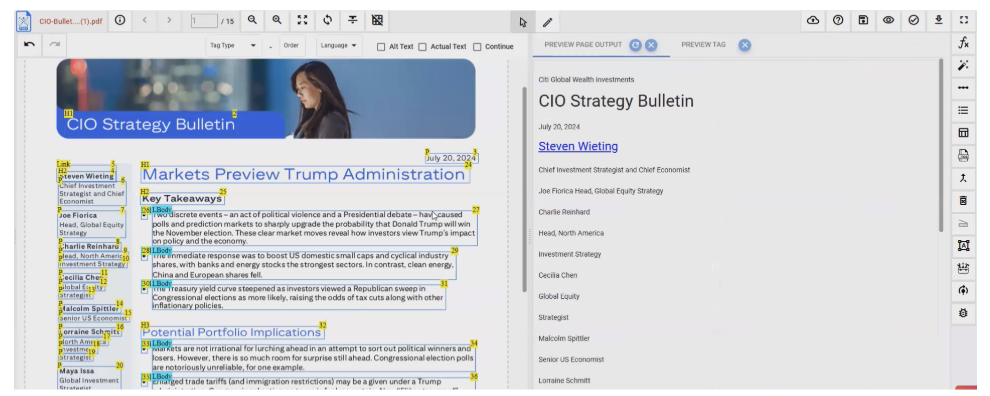
A Complete Guide to PDF Accessibility Checkers: How They Work and Why They Matter

PDF Accessibility Checker

What is a PDF Accessibility Checker?

A PDF accessibility checker helps make sure that a PDF can be easily read by everyone, including people with disabilities. It scans the document to find issues that might make it hard to use, like text that can’t be read by screen readers, images without descriptions, or colors that don’t have enough contrast. These tools help ensure that PDFs are clear, well-structured, and usable for all readers. If a document has problems, the checker points them out so they can be fixed, making the content more accessible to everyone.

What Does a PDF Accessibility Checker Look For?

A PDF accessibility checker helps ensure that people who use screen readers can read and navigate the document without trouble. It scans the file to find anything that might make it difficult for visually impaired users to access the content.

Here are some of the things it looks for:
  • Are all elements properly tagged? Every part of the document, including tables, forms, and links, needs to be tagged correctly so screen readers can interpret them.
  • Do images have alternative text? If an image carries important information, it should have a short description (alt text) that explains what it shows.
  • Is the text searchable? A PDF that only has scanned images of text won’t be readable by screen readers. The checker ensures that the text can be selected, copied, and read aloud.
  • Is there enough contrast between text and background? If the text blends into the background, it becomes hard to read. A good contrast ratio ensures clarity for everyone, including those with visual impairments.
If the checker finds any issues, it highlights them and suggests what needs to be fixed. Making these improvements ensures that the document is easy to read and accessible to all users.

How a PDF Accessibility Checker Works?

Ensuring that a PDF is accessible can feel like a complicated task, but PREP makes it simple by not just checking for accessibility issues but also fixing them in minutes. Here’s how it works:

  1. Upload Your Document

    Start by securely uploading your PDF into PREP. The AI-powered tool will instantly scan your file and analyze its structure. It automatically detects elements like headings, tables, and images, applying relevant tags to improve accessibility.

  2. Review and Adjust

    Once the document is processed, you can quickly review its structure using PREP’s easy-to-use interface. If needed, make adjustments to ensure that content is properly tagged and organized for screen readers and other assistive technologies.

  3. Get a Fully Accessible PDF

    After reviewing, PREP takes care of the rest. It identifies any remaining issues, provides solutions, and applies the necessary fixes to make your document fully accessible. In just minutes, you’ll have a PDF that meets compliance standards and is ready for all users.

    Read More About PDF Accessibility.

What are the Features to Look for in a PDF Accessibility Checker?

  1. Checking Against Specific Standards

    Not all accessibility checkers test PDFs in the same way. Some use broad criteria instead of checking against specific accessibility standards, which can be a big problem. Different industries follow different guidelines, and your PDF must meet the exact rules that apply.

    For example, in the U.S. healthcare industry, compliance is often based on HHS (Health and Human Services) standards, which are built from the Web Content Accessibility Guidelines (WCAG). If an accessibility checker doesn’t allow you to specifically test for HHS compliance, it might miss certain requirements that are essential.

    When selecting a checker, make sure it lets you choose specific, up-to-date accessibility standards instead of just running a basic scan. This ensures your document meets the exact rules needed for compliance.

  2. Manual Verification for Certain Issues

    Some accessibility issues can be checked automatically—like whether an image has Alt text or if a heading structure exists. But there are other things a machine can’t judge properly, and that’s where manual verification becomes important.

    For example, an automatic checker might confirm that an image has Alt text, but it won’t know if the description makes sense. If a picture of a palm tree has Alt text that says “jar of applesauce,” the machine might still mark it as “Passed” when, in reality, it’s incorrect.

    A good accessibility checker should flag these cases for manual review instead of just assuming everything is fine. This ensures that details like Alt text descriptions, logical reading order, and meaningful link text are actually correct and useful.

  3. Checking Metadata and Document Properties

    PDFs have background information, called metadata , that helps users understand the document before even opening it. This includes things like the title, language settings, and file name. While these details may seem minor, they play a big role in accessibility.

    Some PDF checkers don’t pay much attention to metadata, but it’s important to check that the document has the right information. A missing or unclear title, for example, can make it hard for screen reader users to know what the document is about.

    Metadata can be adjusted at any stage—either in the original document before it's converted to a PDF or during the remediation process. When choosing an accessibility checker, make sure it verifies metadata and document properties to ensure a fully accessible document.

How to Check if a PDF is Accessible Using PREP?

Making sure your PDF is accessible is important for users who rely on assistive technologies. PREP offers a straightforward way to check and fix any accessibility issues. Here’s a guide on how to use it:

Step 1: Quick Preview for Initial Checks Quick Preview for Initial Checks
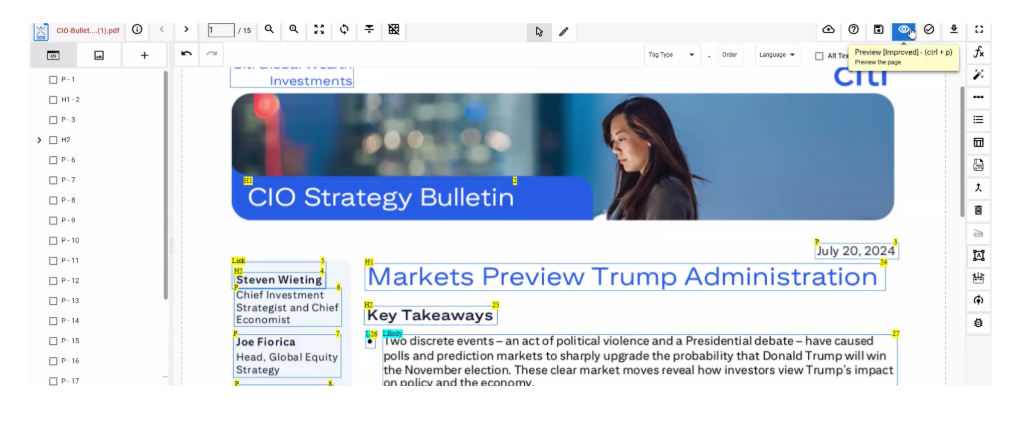
Quick Preview Initial Checks Part 2

Once you’ve made changes to your PDF in PREP, the first thing to do is use the quick preview feature. This gives you a visual overview of your document. It’s a simple way to spot if the basic accessibility improvements have been applied correctly and if the document is looking better in terms of accessibility.

Step 2: Run a Detailed Compliance Check Run a Detailed Compliance Check
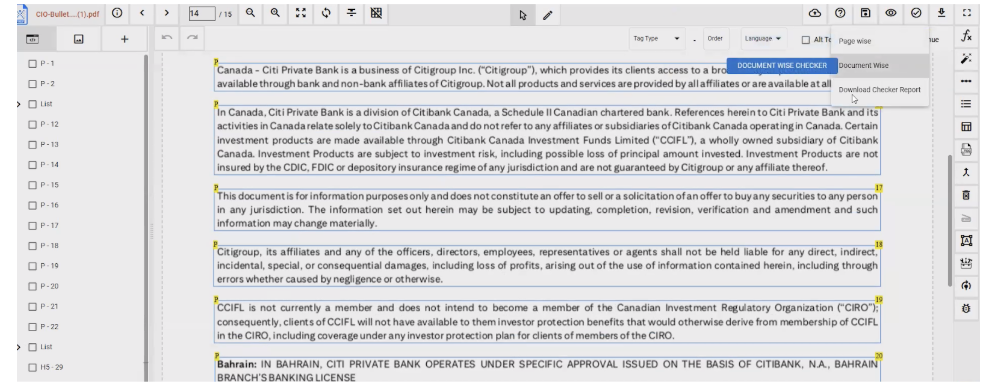
 

Next, to ensure the PDF complies with accessibility standards, you’ll want to run the compliance checker. To do this, click on the checker report icon (a small tick mark located at the top-right corner of the screen). This tool provides a detailed report, flagging any issues that could affect the document’s accessibility.

Step 3: Verify Against Accessibility Standards

Once the report is generated, it will tell you whether your PDF meets various accessibility standards. PREP checks the document against the following guidelines:

  • Section 508: Ensures that electronic and information technology is accessible to people with disabilities.
  • PDF/UA: A standard for making PDFs accessible, ensuring the document can be read by assistive technologies like screen readers.
  • WCAG 2.2 (Level AA): A set of web content accessibility guidelines that help ensure digital content is accessible to a wide range of users, including those with disabilities.

The report will show you whether the document complies with these standards, helping you make sure the PDF is accessible. Step 4: Check Compliance on a Page-by-Page Basis Step 4 Check Compliance on a Page-by-Page Basis
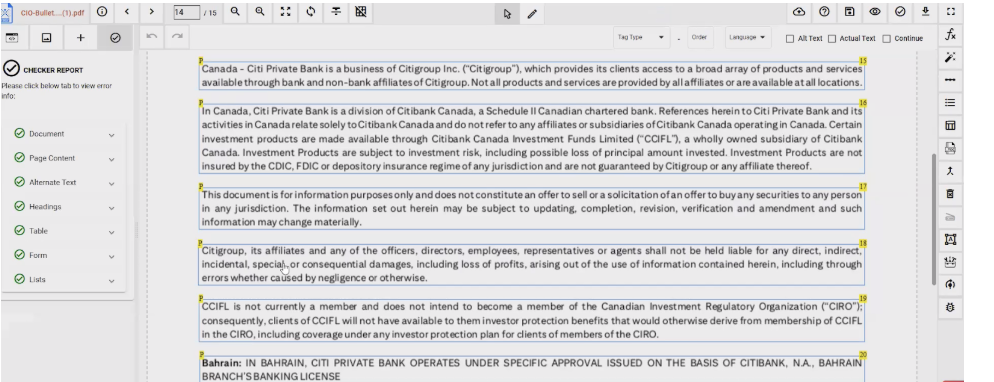
The checker report gives you a page-by-page breakdown of the document’s accessibility. It also includes a document-wide compliance check to make sure that every part of the document follows the proper guidelines. This makes it easier to identify if specific pages or sections need more attention.

Step 5: Download the Full Report for a Detailed Review
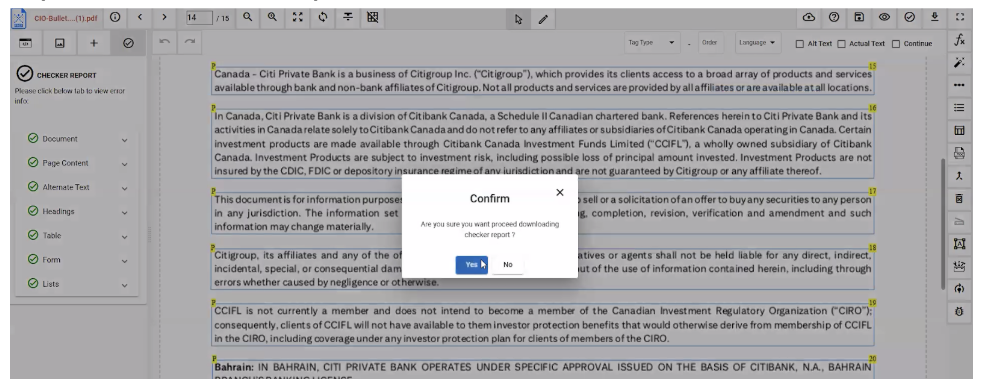
Step 5 Download the Full Report for a Detailed Review

Once the checker report is ready, you can download it for a more thorough look. Having a downloadable version of the report gives you the opportunity to review the findings in detail and share them if needed. It’s a helpful way to keep track of your progress as you work through any issues and make sure the PDF meets accessibility standards.


Step 6: Check if the Text is Selectable

A key part of PDF accessibility is ensuring that the text can be selected. This is especially important for users with screen readers. If the text isn’t selectable, it likely means the PDF hasn’t been properly tagged. You can verify this by simply trying to select the text. If it isn’t working, you’ll need to fix the tagging issues in PREP.


Step 7: Review the Tag Tree for Structure and Accuracy

The Tag Tree in PREP shows how the document is structured. By reviewing it, you can make sure that everything is properly tagged and in the right order. This step is essential for people using screen readers, as a well-structured tag tree makes the content easier to navigate. If any tags are missing or out of place, this is where you’ll find them.


Step 8: Identify and Fix Any Remaining Errors

Even after remediation, there may still be small errors or issues in the document. Use the PREP tool to identify any lingering problems that could affect the accessibility of the PDF. These errors will be highlighted in the checker report, so you can go back and fix them before finalizing the document.

By following these steps in PREP, you can confidently ensure that your PDF is accessible to all users. PREP makes it easy to check your document, fix issues, and verify that everything complies with accessibility standards.


Make PDF Accessibility Effortless with PREP

Struggling to ensure your PDFs meet accessibility standards? PREP simplifies the process with AI-powered auto-tagging, built-in compliance checks, and an intuitive cloud platform. Whether you are an expert or just getting started, PREP helps you create fully accessible documents in minutes, saving time, reducing costs, and ensuring compliance with ADA, Section 508, EAA, and WCAG 2.2.

Explore PREP PDF Remediation Software

Related Posts

Pades - electronic signatures

What is PAdES: Key Features and Types

Learn what PAdES is, how its different signature levels work, and why it matters for secure, legally valid, and long-term PDF verification. Explore its key features, common use cases, industry applications, and how to maintain accessibility in PAdES-signed documents.

Read More »

Do You Need Some Help? Don't Worry, We've Got You!

"*" indicates required fields

Step 1 of 3

This field is for validation purposes and should be left unchanged.
What is your goal?*