What does tagged PDF mean?
A tagged PDF is a PDF file with hidden structural tags (like <H1>, <P>, <Table>, <Figure>) embedded in its code. These tags define headings, paragraphs, lists, tables, and images, and put them in a logical reading order. This lets screen readers and other assistive technology interpret the document correctly, making it accessible to people with disabilities and compliant with standards like WCAG, ADA, and Section 508.What is a Tagged PDF?
A tagged PDF is a PDF that contains a logical structure that identifies the different types of content in the document. These tags tell assistive technologies, such as screen readers, whether a piece of content is a heading, paragraph, list, table, image, link, or another type of document element.
Think of PDF tags as behind-the-scenes labels for the content. A person can see that a line of text looks like a heading, but a screen reader needs structural information to understand that it is a heading and how it relates to the rest of the document.
Tags also create a hierarchy that helps define the logical reading order of the document. For example, a tagged PDF may use <H1> for the main heading, <H2> for a section heading, <P> for paragraphs, <L> and <LI> for lists, and <Table> for tables. This structure helps assistive technologies present the content in a meaningful order.
Tagging is an important part of creating an accessible PDF, but a tagged PDF is not automatically a fully accessible PDF. Other factors, such as alternative text for meaningful images, document language, accessible tables, correct reading order, color contrast, and bookmarks, may also need to be addressed.
List of PDF Tags
| Name | PDF Tag | Description | Essential for Accessibility |
|---|---|---|---|
| Document | <Document> | Root element containing all content in a tagged PDF. | ✅ |
| Headings | <H1>to<H6> | Heading tags indicate the document structure. <H1> is the highest level and <H6> is the lowest level. | ✅ |
| Paragraph | <P> | Paragraph tag, marking blocks of text as separate paragraphs. | ✅ |
| List | <L> | List container that holds <LI> (list items). | ✅ |
| List Item | <LI> | List items, used within <L> for bullet points or numbered lists. | ✅ |
| List Label | <Lbl> | Label tag for list markers (bullets or numbers). | ❌ |
| List Body | <LBody> | List body containing the actual content of a list item. | ❌ |
| Table | <Table> | Table container tag. | ✅ |
| Table Row | <TR> | Table row tag. | ✅ |
| Table Header | <TH> | Table header cell, indicating a column or row header. | ✅ |
| Table Data | <TD> | Table data cell, representing standard table content. | ✅ |
| Table Head | <THead> | Table head section (optional grouping of header rows). | ❌ |
| Table Body | <TBody> | Table body section (optional grouping of data rows). | ❌ |
| Table Footer | <TFoot> | Table footer section (optional grouping of footer rows). | ❌ |
| Figure | <Figure> | Image or graphic content tag. | ✅ |
| Caption | <Caption> | Caption for a <Figure> or table. | ✅ |
| Artifact | <Artifact> | Marks decorative elements (like background images) that should be ignored by screen readers. | ✅ |
| Quote | <Quote> | Marks a block of quoted text. | ❌ |
| Note | <Note> | Marks footnotes or endnotes. | ❌ |
| Reference | <Reference> | Represents references or citations. | ❌ |
| Inline Span | <Span> | Used for inline styling or grouping words for semantic meaning. | ❌ |
| Form | <Form> | Identifies an interactive form. | ✅ |
| Formula | <Formula> | Represents a mathematical formula. | ❌ |
| Code | <Code> | Denotes a block of computer code. | ❌ |
Why is Tagging PDFs important?
-
Ensure Accessibility and Compliance
Tagging PDFs helps businesses meet accessibility standards, which is especially important if your company needs to comply with industry regulations. Many industries require that documents be available in formats that can be read by screen readers, so tagging ensures that visually impaired users can access your content easily.
-
Improve Document Usability
Tagged PDFs make documents more user-friendly, whether for your team or the general public. The tags help organize the content, making it easier to navigate and search through, which saves time and improves the overall user experience.
-
Follow Best Practices for Long-term Use
Tagging documents is part of following best practices, helping ensure that your files remain useful over time. A tagged PDF stays accessible even as technology changes, which means it will continue to work properly in the future. This can save your business from having to redo or update documents later on.
Is a Tagged PDF Automatically Accessible?
No. A tagged PDF is not automatically an accessible PDF. Tags provide the structural information that assistive technologies need, but they must be correctly applied. Other accessibility features, such as meaningful alternative text, correct reading order, document language, accessible tables, sufficient color contrast, bookmarks, and accessible forms, may also be required depending on the document.
How to Check If a PDF Is Tagged?
Method 1- Using PREP
- Upload the Document – Begin by uploading your document to PREP for remediation.
- Automated Tagging – PREP automatically tags the document.
- View Accessibility Tags – Once tagging is complete, you can see the tags in the left panel, just below the PREP icon.
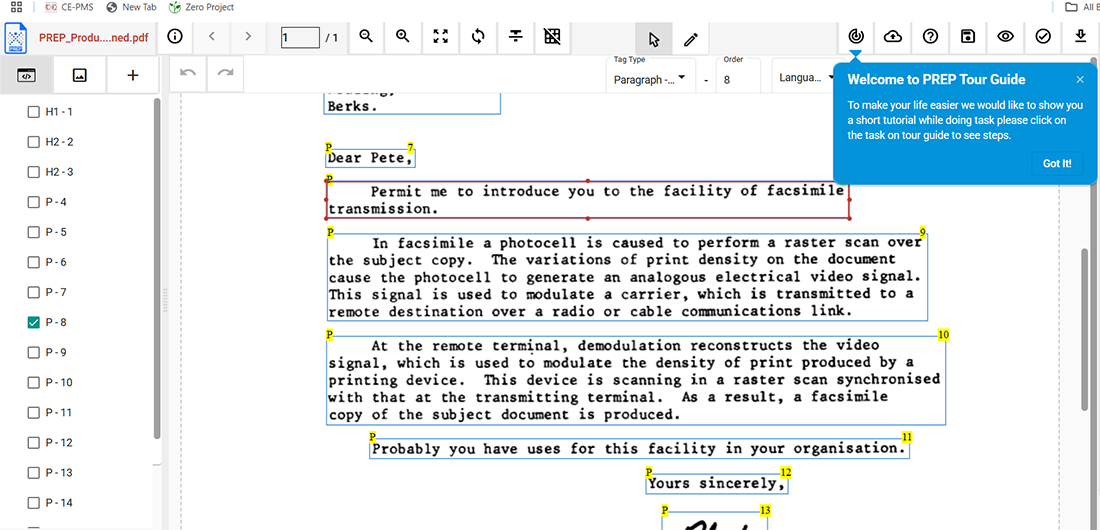
Viewing your document’s accessibility tags - Customize Tags – This section displays checkboxes for different tag types, such as headings, paragraphs, lists, and more.
- Dynamic & Manual Adjustments – The available tagging options change based on the document type and can be manually adjusted as needed.
Method 2: Using the Tags Panel
The Tags Panel is a great way to view the structure of a PDF, including headings, paragraphs, tables, and lists. Here’s how to use it:
- Open the PDF in Adobe Acrobat Pro DC.
- Click on View in the top menu.
- From the dropdown, choose Show/Hide, then select Navigation Panes, and click on Tags.
- The Tags panel will now appear on the left side of your screen.
- To see the structure of the document, expand the tag tree. This will show you the hierarchy of elements, such as headings, paragraphs, tables, and lists. By looking at these tags, you can better understand how the content is organized for accessibility.
Method 3: Using the Reading Order Tool
- Open the PDF in Adobe Acrobat Pro DC.
- Click on Accessibility in the top menu.
- From the options, select Reading Order.
- The PDF will display the tagged structure with numbered boxes that show the order in which the content will be read. This tool makes it easier to check if the reading order is correct for accessibility.
How to Create a Tagged PDF For Accessibility?
-
Manual Tagging
Manual tagging involves adding tags to a PDF document by hand. This process requires the user to go through the document and add tags to different elements, such as headings, paragraphs, tables, and images. This method is time-consuming and requires a good understanding of accessibility standards to ensure that the document is properly tagged. While it provides complete control over the tagging process, it can be a bit overwhelming for users who aren’t familiar with the technical details of PDF accessibility.
-
Auto-Tagging
Auto-tagging is a faster, automated process where a software tool detects the structure of a PDF document and automatically adds the necessary tags. This method is much quicker than manual tagging, but it may not always produce perfect results, especially with complex documents. However, it can be a good starting point, and any issues can be fixed later using manual adjustments. Auto-tagging tools like PREP PDF Remediation and Accessibility Software use AI to make PDFs accessible quickly and easily. This software helps ensure compliance with 508, ADA, EAA, and WCAG 2.2 standards, making your document more accessible with minimal effort.
For organizations that need to automate tagging within their existing workflows, the PREP Auto-Tag API can help integrate automated PDF tagging into applications and systems.If you’d prefer to avoid the hassle of manual or auto-tagging, you can opt for professional help. Continual Engine’s PDF Document Remediation Services offer an easy solution, where experts handle all the tagging and ensure your PDFs meet all necessary accessibility requirements. This service saves time and effort while ensuring your documents are fully compliant with accessibility standards.
By using tools like PREP PDF Remediation Software or opting for expert remediation services, you can easily make your PDFs accessible and meet the latest accessibility guidelines.
Achieve Accurate PDF Tagging in Minutes with PREP
Closing Thoughts
A tagged PDF provides the structural information assistive technologies need to interpret document content. However, correct tagging is only one part of PDF accessibility. After creating or tagging a PDF, review the tag structure, reading order, alternative text, tables, language, and other applicable accessibility requirements before publishing.